
1.Giant-breed dogs: wonderful, special—and genuinely hard work
We talk brachys a lot, but giant breeds deserve honest airtime. Recent VetCompass work looking across millions of UK primary-care records highlighted shorter lifespans for giant dogs than the all-dog average, alongside common causes of death including neoplasia, collapse and cardiac disease.
None of this is anti-giant-breed. They can be magical—there is a presence to a Great Dane’s head sharing your sofa that smaller breeds cannot replicate. But welfare questions around extreme size, day-to-day logistics and breeding priorities deserve calm, constructive discussion.
Breeding better, not louder, is the useful direction. Tools that curb extremes and nudge healthier choices across the board give us a practical way to improve breeding conversations without turning them toxic.
- In practice, giants are a handling, space and equipment puzzle. Height-adjustable tables and walk-on solutions feel like luxuries until you meet an 80 kg patient at 2 am with three people on shift.
- At home, mobility decline and collapse thresholds are different. Owners cannot simply sling-and-help a non-ambulatory giant the way they might a spaniel.
2.Cat quality-of-life tracking: a new tool worth a look
A newly developed owner questionnaire from the Waltham Petcare Science Institute and collaborators uses 37 questions across seven domains, including activity, mobility, sociability, appetite and relaxedness.
The real-world play is serial use: establish a baseline in a young adult, then repeat it after boosters or whenever an owner senses change. A falling score can prompt earlier conversations about pain, mobility, stress or systemic disease.
- The questionnaire takes roughly ten minutes.
- Repeated scores are likely to be more useful than a single snapshot.
- It supports—not replaces—a thoughtful clinical conversation.
3.IV cannulas: ditch the blanket 72-hour change
We welcomed updated guidance moving away from routine ‘change every three days’. If a cannula looks clean, is comfortable, flushes freely and the skin is happy, there is no evidence win in pulling it simply because the clock has ticked.
Some patients have a golden cannula seated beautifully. Replacing it can create new problems and burn scarce veins.
- Inspect sites at least twice daily: unwrap fully and check for pain, heat, swelling and erythema.
- Use an appropriate sterile crystalloid flush and re-dress neatly.
- Let the patient guide you: inspect, flush and decide.
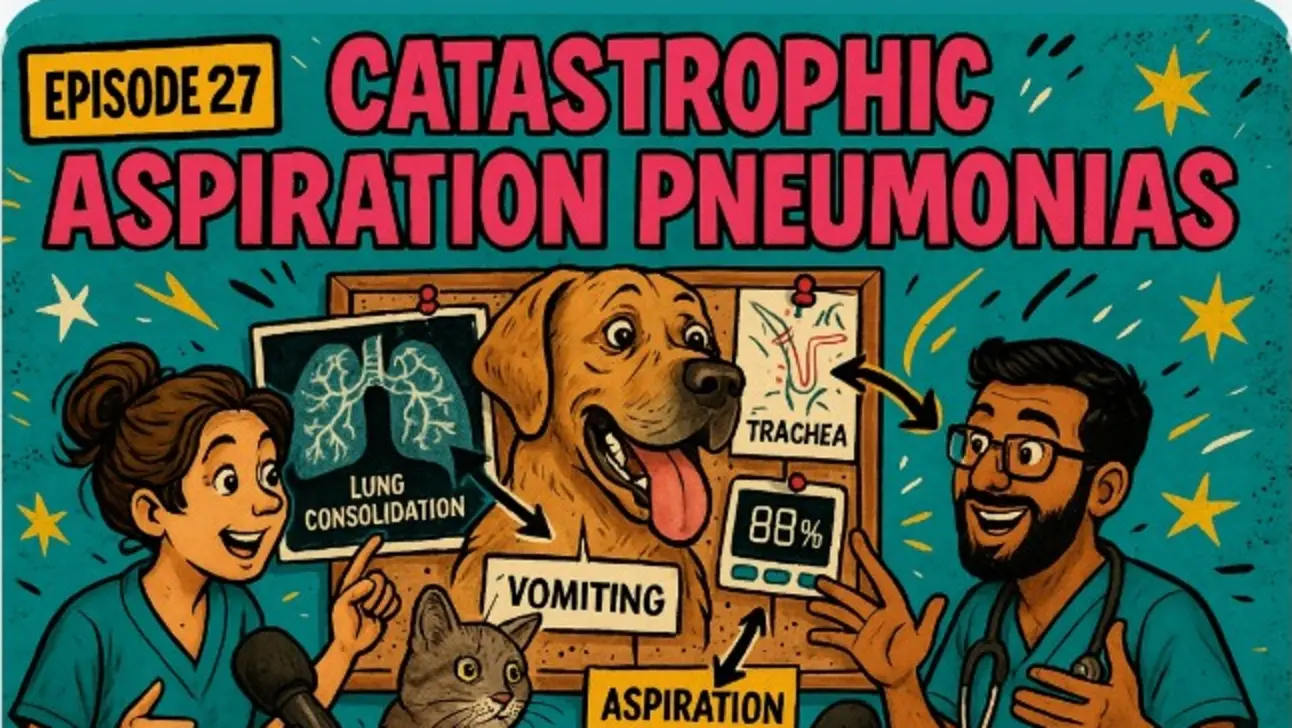
4.Aspiration pneumonia: when it turns catastrophic
Most aspiration pneumonias follow a familiar path. Every so often, one falls off a cliff. We shared a recent case in which a known aspiration led to rapidly coalescing B-lines on POCUS, oxygen-cage management and then dramatic deterioration.
The dog required urgent intubation and IPPV. Despite an apparently solid pulse-oximeter trace, oxygen saturation remained critically low. The team provided intensive support, but the patient later crashed and, in accordance with its DNR, was not resuscitated.
- Be honest early. If you expect deterioration before improvement, say so—even if the dog is not blue yet.
- Have the intubation plan ready. For aggressive or high-risk patients, stage sedation plans, lines and equipment.
- Trust the clinical trajectory more than any single monitor number.
5.Wearables for oxygenation: promising, but not ready yet
It is tempting to repurpose human paediatric wearables. A veterinary assessment of the Owlet Smart Sock in awake patients found limited agreement for oxygen saturation.
The practical conclusion is simple: interpret it with caution. It is not yet a plug-and-play answer to our oxygenation blind spots.
6.Burnout, moral injury and the bit we do not say out loud
The clinical parts of this episode were heavy—and that is the point. ECC and medicine expose us to repeated high-stakes, high-emotion work. You can feel you did everything and still carry the outcome. That is not weakness; it is the job colliding with being human.
What helps is having colleagues who get it, support at home, accepting that part-time work is not a magic wand, and making space to celebrate the wins rather than only dissecting the losses.
Please use the support that exists, including Vetlife in the UK. If you are not okay, that matters more than any rota.
7.Policy watch: Veterinary Surgeons Act reform edges forward
We flagged government proposals to overhaul the 1966 Act. Ideas under discussion include an independent veterinary ombudsman, regulation of veterinary businesses as well as individuals, protected professional titles and modernised fitness-to-practise processes.
It is still a journey, but momentum matters—particularly the move towards regulating businesses rather than placing the whole burden on individual professionals.
8.Dentistry, London Vet Show and the last word
We shared more from our conversation with Jonathan at Frost Dentistry, with further features to follow, and looked ahead to the London Vet Show.
We can hold two truths: giant breeds can be pure magic and a welfare and logistics challenge. Aspiration pneumonias are usually manageable—until one is not. Our IV habits can modernise without making life harder. None of it works unless we look after each other as carefully as we look after our patients.
- New feline quality-of-life tools may help owners notice change sooner; serial scores beat one-offs.
- IV cannulas do not need an automatic 72-hour change: inspect, flush and decide.
- Aspiration pneumonia can deteriorate rapidly, so stage oxygen and intubation plans early.
- Burnout is not a character flaw; build supportive habits that celebrate wins as well as learning from losses.
Listen to the full episode for the discussion, context and the bits that made Charlotte and Brendan laugh.
Listen to Episode 27